




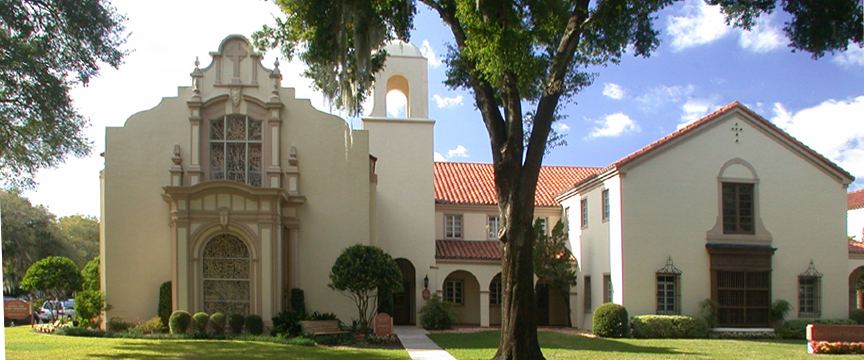


First United Methodist Church

Service Times

9am Contemporary | 11am Traditional

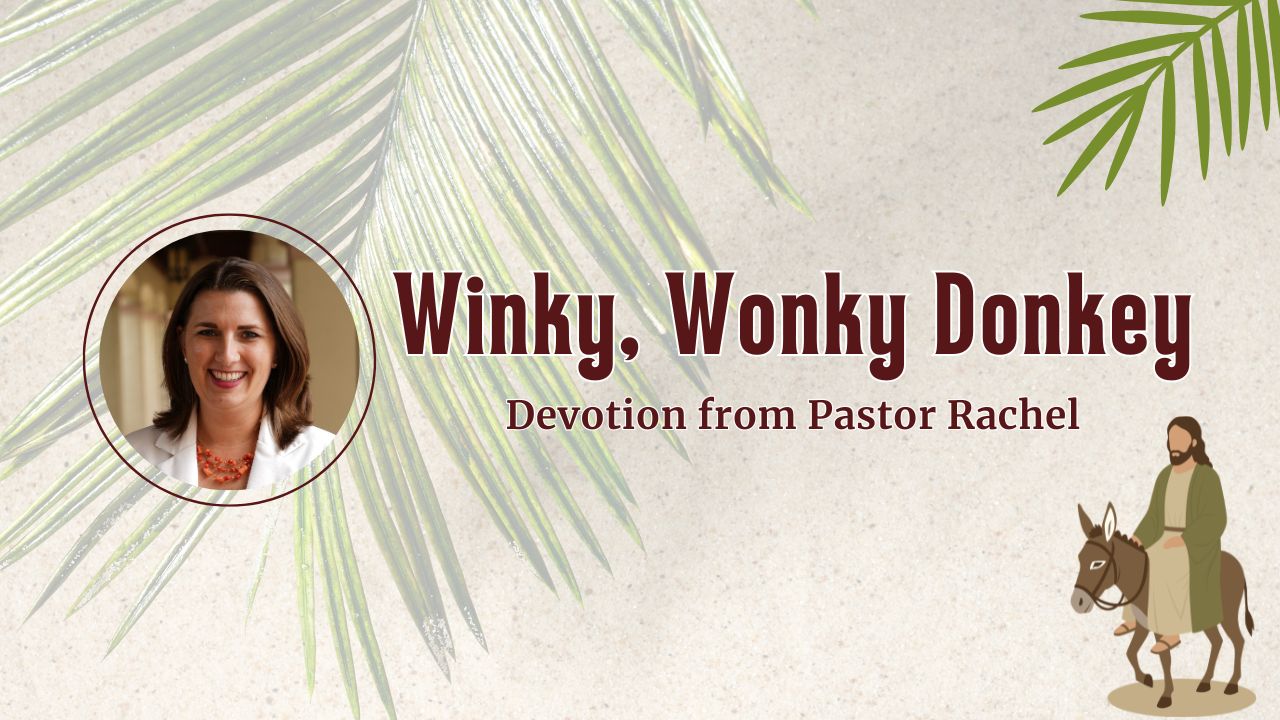
Devotion: Winky, Wonky Donkey

As we begin preparing for Holy Week and the joyous time of Easter, I have had a tradition in our Preschools that I wanted to share with you. Every year, I have had a chance to read the Winky, Wonkey Donkey story to our Preschoolers at Chapel for both Trinity Christian Academy and Methodist School for Early Education. If you have never read the story, it is a joy! It follows a donkey that is having a really bad day and page after page, we learn that something else is now wrong with him. I talk to the little ones about our bad days and ask them if they have ever felt cranky, or naughty or dealing with something that sets them back. I remind them that Jesus loves them anyways, even when they are feeling those things.

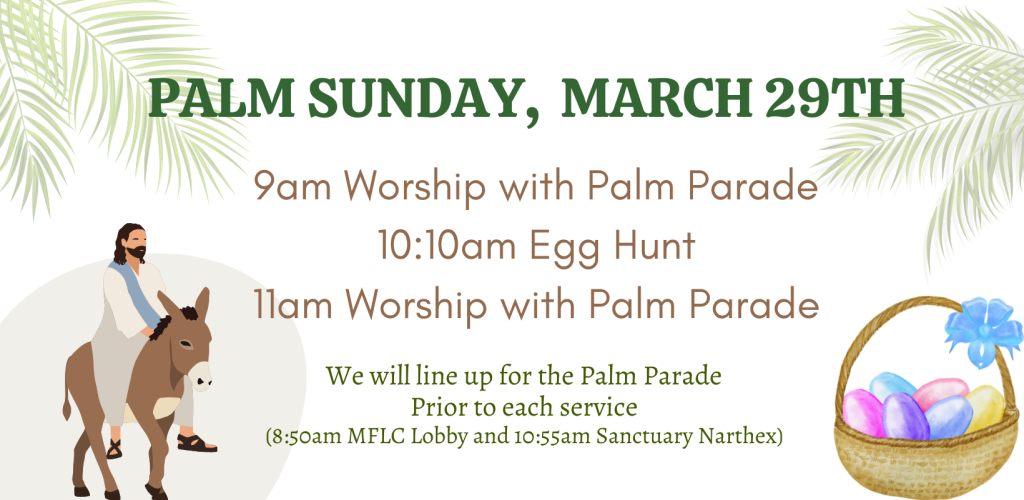
Then, I try as best as I can to connect the Winky, Wonky Donkey back to the story of Palm Sunday. I teach the kids about the parade that Jesus came into Jerusalem in. I talk about the donkey he rode and the people that waved palm branches and shouted Hosanna! And then I tell them that while we don’t really know how stinky or naughty the donkey was that Jesus rode into the city on, we do know that God loves us and can use us even on our worst of days. We have fun telling the story with motions and laughing about the Winky, Wonky Donkey. Look the video up on YouTube to listen to the story. It is worth your time.

And after I shared this story over the last few days, it go me thinking about the crowd of the people shouting Hosannas and waving palm branches, and I had wondered if I would have been amongst them? Here is why I ask you this question. There were two processionals through Jerusalem in the year AD 30. The first was Pilate’s Imperial Procession coming from the West. To ensure order during the crowded Passover festival, the Roman governor, Pontius Pilate, would ride from his coastal residence in Caesarea into Jerusalem. Author and Theologian, Brain Zahnd writes, “What we see on Palm Sunday are two parades. One from the west and one from the east. One where Caesar’s Prefect of Judea rides a warhorse and one where God’s anointed Messiah rides a donkey. One is a military parade projecting the power of empire, the Roman Empire. The other is a prophetic parade announcing the arrival of an alternative empire, the kingdom of God. One parade derives its power from a willingness to crucify its enemies.”

Scholars believe this was intentional and planned by Jesus and his followers as an “anti-imperial” counter processional that would have put those present at the parade in some risk. Not only that, but in all three Synoptic Gospels, those in the crowds laid down their clocks and outer garments which was a public display of allegiance and hope in the new Kingdom Jesus came to usher in.  In those days, your outer garment was also your blanket and your security and so to lay that down signaled a willingness to be sacrificially obedient for this new, counter kingdom.

And so, as we walk closer and closer to Holy Week and as we prepare for the sting of death and the hope of resurrection, I invite you to consider two things. First, would you have even been willing to put yourself at risk, to go against the degree as a citizen of Rome to join the crowd that celebrated Jesus’ final entry into the Holy City. And second, if you were there, what would you have laid down? Throughout this season of Lent, you may have chosen to let go of something or to take something on. But as we prepare for the Holy Season of Easter, what is the final thing God is asking you to lay down to prepare fully for the freedom found through death and resurrection?

Maybe it is your ego, your false self like Pastor Philip preached about Sunday. Maybe it is your anger or your bitterness towards others? Could it be your pride or your entitlement? Or maybe it is your fear of what will come to be in this world that seems to be spinning out of control. What is that outer layer that has been your security and comfort and whatever it is, would you have been willing to lay that down?

As we prepare for how God might show up in our lives over the next ten days, may we be watching and listening to how God might be inviting us into a new way of loving, a new way of living and a new way of living into the hope that just like the Winky, Wonkey Donkey, Jesus loves us even on our worst of days.

Winky, Wonkey Donkey Read Aloud: https://www.youtube.com/watch?v=VKzrYLuI6Yo

Devotion: Reflections from Our Recent Civil Rights Pilgrimage

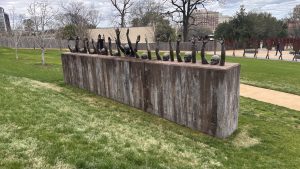
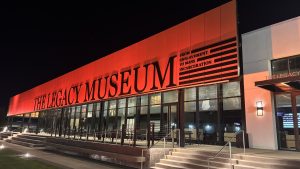
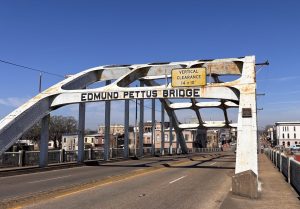
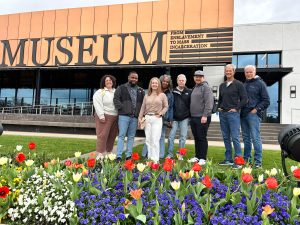
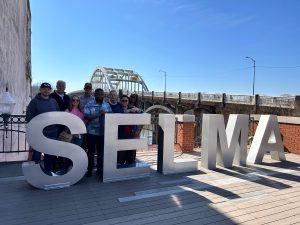
Last week, eight of us from First United Methodist Church Winter Park traveled to Montgomery, Alabama on a Civil Rights Pilgrimage. We visited the National Memorial for Peace and Justice, the Legacy Museum, the Rosa Parks Museum, and traveled to Selma where we worshipped together and shared Holy Communion on the Edmund Pettus Bridge. We were guided by Rev. David Williamson and Rev. Laverne March of Belonging, Inc., an organization that leads groups through cross-cultural dialogue and equity work. It was three days of walking, listening, and looking at hard things together.

Today, I want to tell you a little about our journey.

The Legacy Museum is unlike anything I have experienced. Room after room tells the story of slavery, lynching, segregation, and mass incarceration in America. Not abstract history. Specific names. Specific places. Specific dates.

I found a name from my hometown.

Elijah Clark. Huntsville, Alabama. July 23, 1900. Lynched, along with many others, eighty years before I was born, in the city where I grew up.

I was raised in Alabama. I was taught that the Civil War was the “War of Northern Aggression.” I was taught that slaveholders were, by and large, kind and benevolent. I was never taught about Elijah Clark or that lynchings even happened.

Looking back, it is obvious. This was not an accident.

This week’s scripture is Ephesians 5:8-14 (NRSVUE). Paul writes, “For once you were darkness, but now in the Lord you are light. Live as children of light, for the fruit of the light is found in all that is good and right and true.” 

That’s where a lot of us want to stop. We are the light. We are the good ones. We know better. But Paul doesn’t stop there.

“Try to find out what is pleasing to the Lord. Take no part in the unfruitful works of darkness, but instead expose them. For it is shameful even to mention what such people do secretly, but everything exposed by the light becomes visible, and everything that becomes visible is light.”

This is the paradox Paul highlights: exposure itself is a form of redemption. When we cease to look away, stop spreading comfortable lies, and finally name darkness, a change occurs. The light not only illuminates but also transforms our world. Acknowledging these events is crucial; it opens the door for the light to enter and bring change.

The museum ends with pictures of black children. Smiling, laughing, and just being kids. And I stood there undone. How do we still not see this? Although we have made significant progress since the 1960s, society still lacks true equal justice. Not yet. Not while Black children are six times more likely to be shot by police than white children. Black Americans are incarcerated at over five times the rate of white Americans. Black women also die in childbirth at three times the rate of white women. And we continue to teach sanitized versions of our history, so as not to make waves and so we all can “move on.”

And then we went to Selma.

We stood on the Edmund Pettus Bridge. The same bridge where on March 7, 1965, six hundred people were beaten back by state troopers with clubs and tear gas for trying to march for the right to vote. It’s called Bloody Sunday. We stood next to that bridge, and we broke bread together. We shared the cup together. We took communion on the ground where people bled for dignity.

I don’t have words for what that felt like. I’ll just say this. The table has always been a place where broken things get named and held. We saw the light, our eyes were open.

That is what Paul means when he says, “Therefore it says, ‘Sleeper, awake! Rise from the dead, and Christ will shine on you.'” Ephesians 5:14 (NRSVUE)

This pilgrimage was a wake-up for me and others, and I hope that more people can experience this in the future. Because you cannot live as a child of light while refusing to look at the darkness. You cannot find what pleases God while protecting yourself from the uncomfortable truth. You cannot bear the fruit of what is good, right, and true while sleepwalking through history.

Devotion: Trust – Learning to Rely on Grace

When I was a Team member at Warren Willis Camp, every week we would take our Small Groups to the Ropes Course early in the week to create a sense of strong communication and teamwork. I have served as a counselor for four years and have worked with elementary, middle school and high school individuals in this formidable time as they ask questions about faith, the Bible and how we are to follow Jesus in today’s world. In every Rope’s Course activity, we have what is called the Trust Fall and it can be done two different ways. One way is in a circle where you close your eyes, link up your hands, fold in your arms and plant your feet. Once you close your eyes, you lean back in the circle and hope and pray that your fellow campers catch you. The other way of doing this activity is up on a 6-foot ledge that you fall from and hope that you fall into a group of campers and adult volunteers that catch you like you are crowd surfing at a concert. Both experiences require some trust and both experiences bring up some anxiety for folks because we are conditioned early on to look out for ourselves and to not just fall blindly where we cannot see. They also teach us about Trust and relying on grace.

When I think about this Lent Week Three focus, I am reminded of this image of the Trust Fall. This classic activity at camp is the foundation for all that we do in faith, because much of what we hope in is outside of our control. When we trust Jesus with our callings and career choices, we don’t know where we will end up. When we trust our marriages and child-rearing to Jesus, we may feel more vulnerable than we would like. When we trust Jesus with our finances, we may worry about scarcity or lack of security. When we trust Jesus with our anger and bitterness, we may not get to have the final word.

And so why do we do it? Why is it often times difficult to trust and what does it mean to rely on grace?

If we carry through with the metaphor of the Trust Fall, our faith in Jesus means that we are sometimes not in control. By closing our eyes and locking our hands we are signaling that we don’t know what happens next and we can’t control the outcome. This is a scary notion and one that takes trust to see it through. The lack of control is an essential part of trusting Jesus because He orders our steps and walks beside us in uncomfortable situations. I remember the words of a seminary professor who told us that Jesus came to comfort the afflict and afflict the comfortable. I feel that I am the latter one in that example and I have lived a mostly comfortable life. And so trusting that Jesus will walk with me through situations that I don’t choose and that I might not feel ready for is a part of that trust. Remember Jesus never asked us to believe in Him, but to follow him. When we rely on grace, we are choosing to follow even if it all doesn’t make sense.

Stick with the Trust Fall example for a moment longer, and picture the first way of falling in a circle, surrounded by the group of other campers. I fall in whatever direction the group gently nudges me. While I trust the community of faith that surrounds me, really relying on grace is the peace we feel when we know that whatever we walk through, we have a community of Jesus followers that surround us, support us and hold us in prayer.  And that is the gift of grace. When we can’t do it alone and we run out of steam, it is the community of Jesus followers that gently nudges us, directs us and protects us. I have watched this happen over and over again in the churches I serve and in the faith communities that I am connected to because this is the incarnation of grace. And by relying on God’s Grace, it stretches us and reminds us that we are all connected.

And so I ask you to think this week about where you are struggling to trust. Is it in your fear of the unknown? Are you struggling to trust a person, a leader, a system? Are you struggling to trust yourself or friend or a loved one? Name that, know that and bring it to God in prayer. And then I invite you, as you pray over that area of distrust to look for the people that might be able to hold you up and support you as you find your way. That is where grace enters in and that is how God’s Spirit strengthens us through community.

 Praise be to the Lord,
    for he has heard my cry for mercy.
The Lord is my strength and my shield;
    my heart trusts in him, and he helps me.
My heart leaps for joy,
    and with my song I praise him.

                        Psalm 28:6-7